The full bid lifecycle.
Not a proposal generator. A studio that carries a deal from the first signal to the signature, and keeps what it learned.
Agents under rules, humans at the gates.
The same three principles as everywhere else: the craft of the best bid people is the target, the whole cycle is in scope from day one, and the deal knowledge is what remains.
Specialized agents, explicit rules
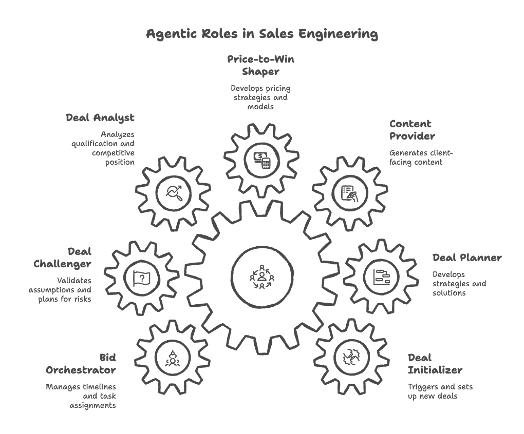
The studio is not one assistant. It is a set of roles - qualification, content, planning, orchestration, pricing, challenge, analysis - each with a defined scope and each operating under written rules. Those rules are readable, arguable and versioned. Nothing runs on an implicit prompt.
Human validation at every gate
The agents prepare, structure, challenge and produce. The decision stays human at every gate: qualification, solution, price, storyline, submission. This is not a safeguard bolted on afterwards; the review gates are the backbone of the design.
Deal memory
Bid knowledge is normally lost twice: when the team disbands, and when the next bid starts from a blank template. The studio keeps a structured memory of the deal - decisions, arbitrations, pricing logic, what convinced and what did not - so knowledge compounds from one deal to the next.
Continuous challenge
A dedicated role does nothing but attack the deal: assumptions, blind spots, the credibility of the delivery story, the price position. Being challenged early by a machine that has read everything is cheaper than being challenged late by the client.
Where strategic deals are lost.
Twenty-five years of large pursuits, and the same four causes. None of them is the solution being wrong.
The solution is almost never the cause. Deals are lost on a poor reading of where the real power sits.
Price is framed too late, or without competitive discipline.
Execution degrades under pressure: the storyline and the client's perception go with it.
Without rigorous orchestration, the critical moments are left to chance.
How it fits together.
Click any diagram to enlarge it.
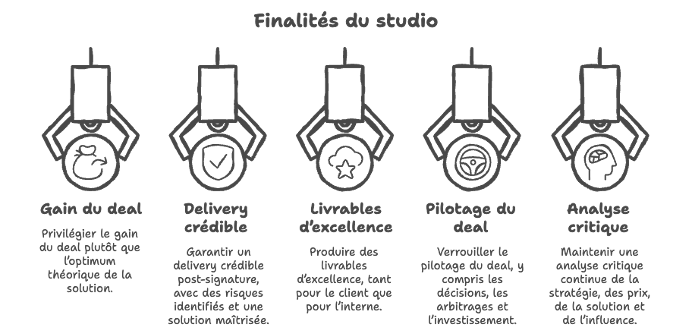
Purposes of the studio
Five purposes driving every engagement: win the deal, ensure credible delivery, produce excellent deliverables, steer the deal end-to-end, and keep critical analysis running.
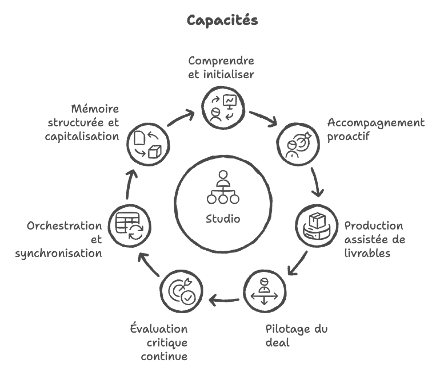
Seven capabilities
Understanding and initialisation, proactive engagement, assisted production, deal steering, critical evaluation, orchestration, structured memory - interlocking around the studio.
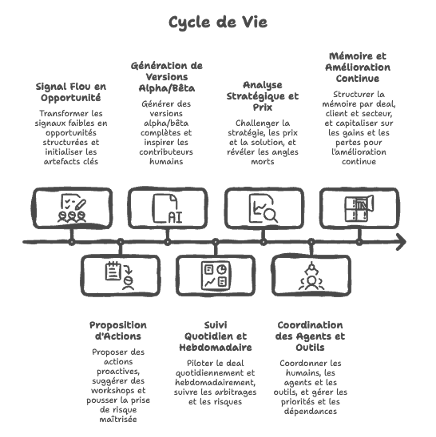
Deal lifecycle
The operational cadence: signal detection, opportunity initialisation, versioned deliverables, strategic and pricing analysis, and the coordination of agents, tools and human experts on a daily and weekly rhythm.
Agentic roles
Seven specialized roles - price-to-win shaper, content provider, deal planner, deal initializer, bid orchestrator, deal challenger, deal analyst - working as interlocking gears around the human team.
A studio, not a sales tool.
Nothing in the architecture is specific to selling. Specialized agents, explicit rules, human validation at defined gates, structured memory: the same skeleton fits any function where experts make consequential decisions over a long cycle.
Functions it transfers to
Each new studio reuses the same base: agents, rules, validation, memory. What changes is the craft it learns.