Human-first. End-to-end. Knowledge-first.
Jérôme Fenyo - independent AI-First consultant, Goyave Consulting. I transform the craft of leaders and experts, and build the systems myself, in their real environment. For large organizations.

Two conditions. Three places.
Scale is where AI programs stop. 95% of generative AI pilots deliver no measurable P&L impact (MIT NANDA, 2025). Fewer than 10% of deployed use cases pass the pilot stage, and more than 80% of companies report no tangible effect on enterprise EBIT (McKinsey, 2025). Three measurements of one fact: a use case can succeed and the organization stay exactly as it was.
The question is what has to be true for a transformation to hold at company scale. Two conditions make it hold anywhere: a way of working, and somewhere the knowledge accumulates. Then it has to land in three places: on the leaders who decide, on the business functions that produce the value, and on the application estate that keeps everything running. Goyave Consulting covers the five, one offer each. Together they are the frame: the minimal structure an organization puts in place so that an AI transformation reaches production and holds there.
The method, written down.
The frame I work from, set out in full: what a large organization has to put in place to make AI hold, from the leadership down to the application estate. Forty-eight pages, eighteen diagrams - the three convictions, the five offers, and the argument that ties them together. Edition 2026, in English.
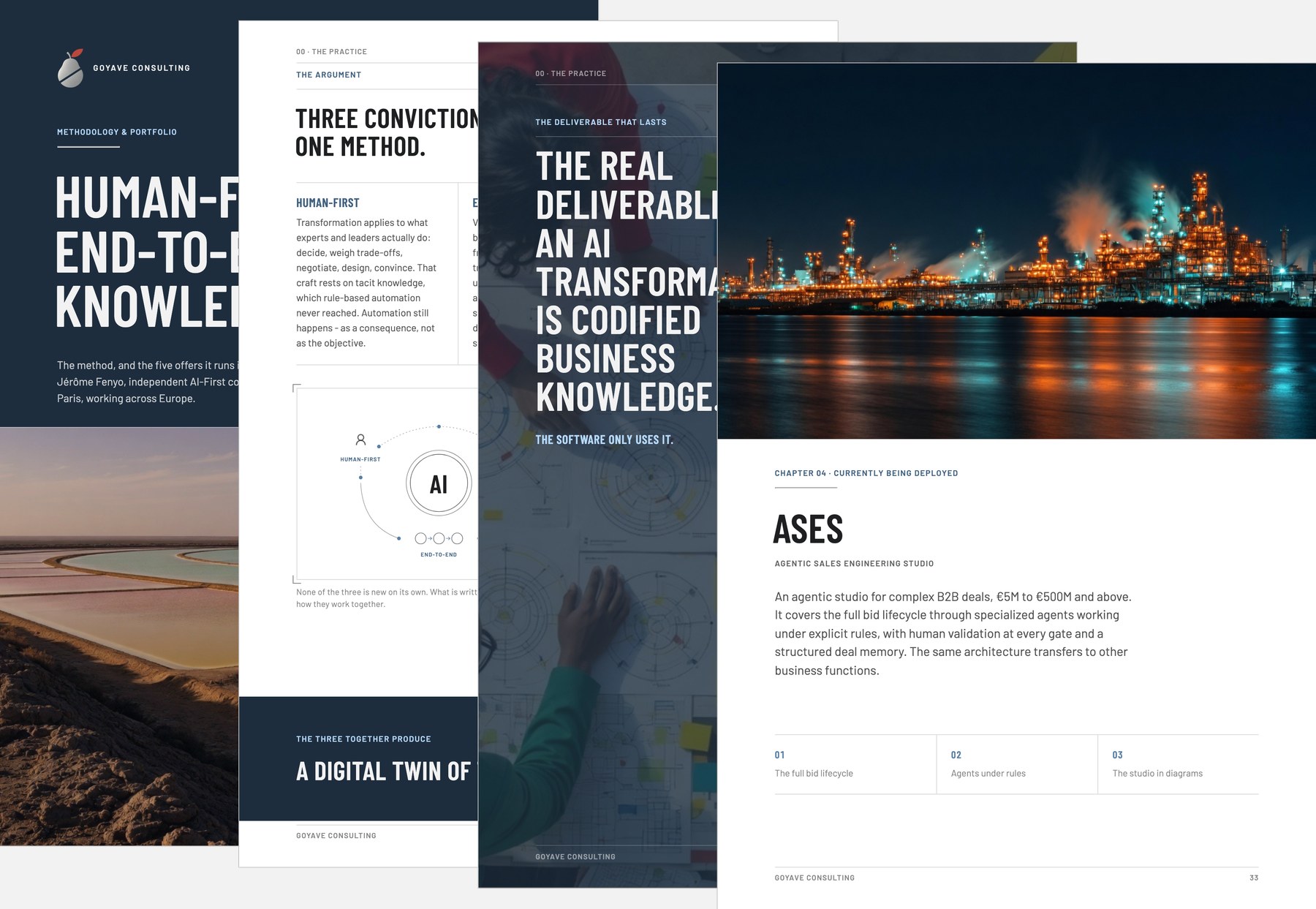
Three convictions,
one method.
Human-first
Transformation applies to what experts and leaders actually do: decide, weigh trade-offs, negotiate, design, convince. That craft rests on tacit knowledge, which rule-based automation never reached. Automation still happens - as a consequence, not as the objective.
End-to-end
Value sits in the connections between steps, not in the fragments. Splitting a transformation into isolated use cases optimizes fragments and produces pilots that never scale. The full scope is designed immediately; delivery stays progressive.
Knowledge-first
The durable deliverable is the business knowledge captured and structured while building. AI collapses the cost of capturing it: no forms, no taxonomy, it is picked up in the flow of the work. Once that knowledge exists, the software can be rebuilt in days.

The five offers
Approach & foundation
AI-First
The approach
In active use.
Read →Delivery
How a project runs
The method, in six moves.
02Craft Twin
The foundation underneath
In use on my own engagements.
Read →Leaders · functions · estate
AILC
AI Leadership Compass
Executive AI coaching
Program running.
Read → 04ASES
Agentic Sales Engineering Studio
Agentic B2B sales
Currently being deployed.
Read → 05iAM
Intelligent
Application Management
White paper published, 2025.
Read →AI-First is the way of working, and it comes in two halves. The convictions say what to aim at - human-first, end-to-end, knowledge-first, argued in full above. The method says how a program runs: immersion rather than up-front scoping, a prototype and a pilot on one cadence, the harness from day one, integration treated as the critical path. Scope is total from the start, delivery stays in slices. None of the three convictions is new on its own. What is mine is not the idea: it is executing all three together, and writing down how.
Craft Twin is where the knowledge accumulates. At scale the binding constraint is retention: what a program learns leaves with the people who learned it. Craft Twin turns what a team already produces - meetings, mail, chats, documents, data - into a memory its experts can query, sourced and dated, and at its deepest level a twin of how a role decides. Four depths, you stop at yours. The application on top is replaceable, the knowledge is not. The three offers that follow plug into it, each at a different depth.
AILC lands on the leaders. At scale, the people who arbitrate decide whether the rest holds. Two days: day one they write their own doctrine, day two they build and govern a personal AI working system they keep. The rule holds on both days: the executive decides, AI executes.
ASES lands on a business function. The effects that count at enterprise level appear when the craft itself changes. ASES is the first studio: specialized agents under written, versioned rules, human validation at every gate, a structured deal memory, on complex B2B deals. The same architecture fits any craft where experts make consequential decisions over a long cycle, and the studios that follow will be built on it · finance · human resources · procurement · supply chain.
iAM lands on the estate. Most of the IT budget and most of the people are there, and almost none of the AI conversation is. iAM covers the estate: break-fix to prediction and autonomy, ticket automation, AIOps and self-healing, knowledge that stays alive under operational volume. With the guardrail the white paper states: silent intelligence must not become opaque intelligence.
On a project, that frame has a name: the harness. Enough structure to keep the move into production within reach, little enough to leave experimentation free. This is the same idea, at the scale of a company.

Immersion
Weak signals, real usage, available data - then contact with the craft itself. Not up-front scoping.
Prototype & pilot
Two tracks on one cadence, three-week increments, slightly offset. They converge at delivery.
Digital twin
Business knowledge captured and structured, held by a specialized agent. The deliverable that lasts.